
NextCell Reports Positive 7-Year Data for its Stem Cell Candidate, ProTrans, for Type 1 Diabetes

Long-term follow-up suggests ProTrans may help preserve insulin production, with results varying by dose.

Key findings

  • Durable effect observed ≥7 years from first infusion
  • Sustained preservation of endogenous insulin production at group level
  • Clear dose-dependent trends over long-term follow-up

NextCell Pharma AB announced long-term follow-up results from its ProTrans-Repeat study, reporting sustained preservation of endogenous insulin production in patients with newly diagnosed type 1 diabetes. ProTrans is NexCell’s umbilical cord-derived mesenchymal stem cell therapy candidate.

According to the company, the new analysis extends to approximately 6 years after the last ProTrans infusion, which is roughly 7 to 7.5 years since the first infusion.

At this latest follow-up, NextCell has found different trends by dose group:

  • High-dose: Preserved endogenous insulin production, and two of three patients continued to show insulin production close to baseline, while one showed a more pronounced decline.
  • Intermediate-dose: Limited preservation.
  • Low-dose: Progressive decline over time.

NextCell argues that the preservation of insulin production for more than seven years after the first infusion is unexpected in type 1 diabetes, and that the dose-dependent pattern supports the biological rationale for ProTrans.

“A single infusion of ProTrans has demonstrated such a high and durable clinical impact that our strategy is to bring this treatment to patients as quickly as possible. At the same time, I am encouraged by the long-term results from ProTrans-Repeat, which show sustained efficacy over extended follow-up and confirm that ProTrans can also be safely and effectively administered repeatedly if needed,” says Mathias Svahn, CEO of NextCell.

What’s next?

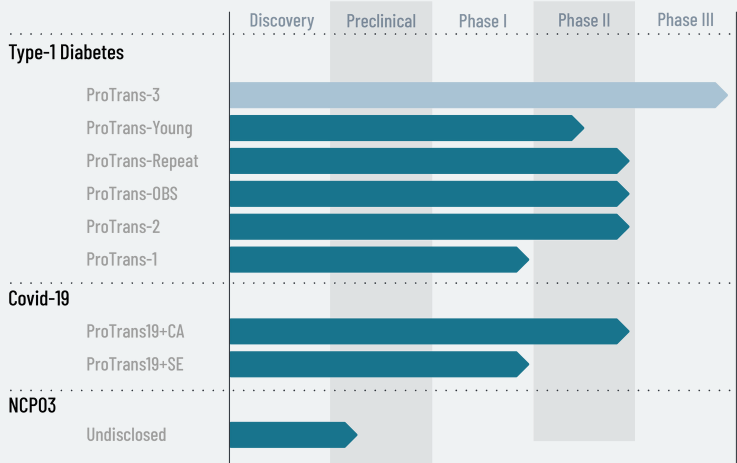
NextCell says its primary objective is to pursue ProTrans as a single-infusion treatment and seek market approval on that basis, since that is where they have the most data. Following market approval, NextCell intends to expand the label to include pediatric patients and evaluate repeated ProTrans infusions to potentially maximize and prolong the effect in selected patient groups.

Here’s their current pipeline:
Company snapshot

NextCell Pharma is a clinical-stage cell therapy company developing ProTrans, a patent-protected platform based on allogeneic mesenchymal stromal cells (MSCs) derived from umbilical cord tissue. NextCell uses a proprietary selection algorithm to tailor the cells to specific indications. The company states that a Phase III trial is planned to begin after it secures a commercial partner. ProTrans is also being evaluated for other autoimmune and inflammatory conditions.

NextCell’s subsidiaries include Cellaviva (a private stem cell bank) and QVance (a provider of quality services for developers of advanced therapies).

Want to keep up on regenerative medicine? Get the weekly newsletter here.
If you found this post helpful, would you mind sharing it? ⬇️ 

Related:

Lineage will evaluate the new gene-edited iPSC line for immune compatibility and manufacturing potential before pursuing exclusive rights with Factor Bioscience.
The proposed legislation, if passed, will allow culture-expanded autologous mesenchymal stem cell therapies in the Cowboy State.
Based on Phase IIa trial data where 85% of patients had resolution of chronic fatigue over 20% with placebo, the company will now offer its cord blood cell therapy outside of the Phase III soon.
The company's autologous cartilage repair product will now be reimbursed under national health insurance, WOMAC scores improved better than hyaluronic acid injections.
After stepping back from stem cell therapies last year, Novo is passing the torch on diabetes cell therapies to Aspect Biosystems, who will continue to commercialize the tech.

The Latest:

The new registry aims to address evidence gaps and track long-term outcomes for orthobiologic treatments.
The collaboration will assess whether robotic automation can help scale up cell therapy manufacturing while maintaining GMP standards.
The partnership aims to streamline production and quality testing of gene-edited hematopoietic stem cell therapies for HIV and rare diseases.
With the right secured for stem cell potency, Longeveron is continuing its path forward with clinical trials for several mesenchymal stem cell indications.
The new open source gene editing services are ready to help iPSC developers create off-the-shelf allogeneic cell therapies at scale.
Polyphron will use Cellino's induced pluripotent stem cells in its "autonomous tissue foundry" to reproducibly manufacture cell and tissue therapies at scale.
The new CellFiber Extruder aims to address manufacturing bottlenecks in cell therapy by enabling scalable, GMP-compliant cell production.
Researchers report that intranasal Muse cells improved motor function and reduced neurodegeneration in a Parkinson’s mouse model.
Stemchymal's CDMO has been selected, while the company seeks conditional approval in both Japan and Taiwan following Phase II results.
Resbiomed, a placental collagen materials manufacturer, is working on scaling up production for what appears regenerative ophthalmology in Europe.
The trial found no significant difference in pain or function outcomes between bone marrow injections and sham procedures over 12 months, but also had important limitations.
The new platforms aim to streamline large-scale production of iPSC-derived cell therapies for new indications.

Discover more from Regen Report

Subscribe now to keep reading and get access to the full archive.

Continue reading

Stay updated on Regenerative Medicine