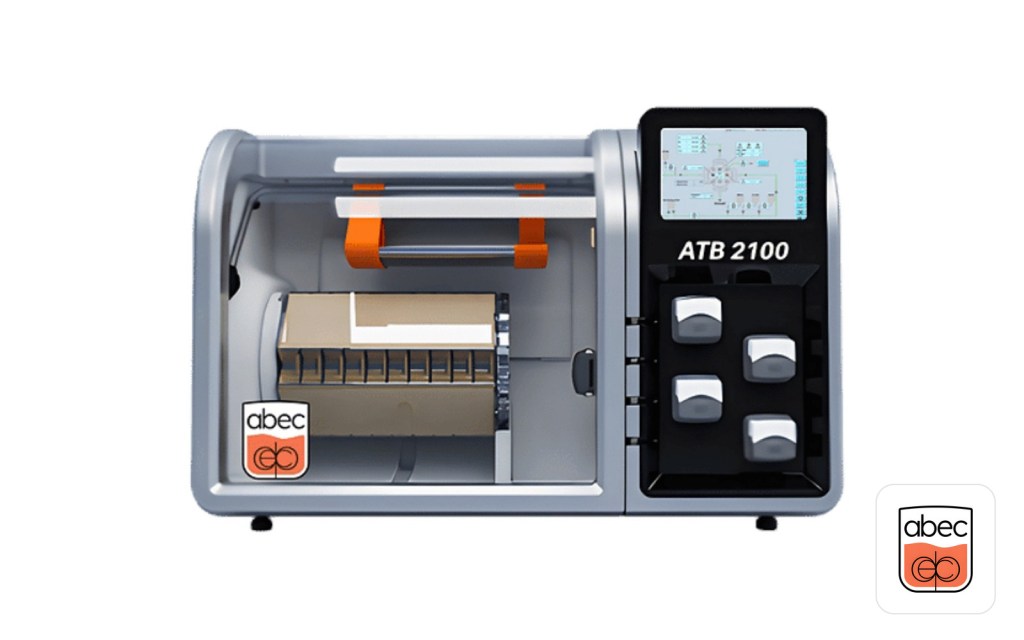
ABEC Launches ATB-2100 Advanced Therapy Bioreactor for Cell and Gene Therapy Manufacturing
The closed, automated single-use system is designed to support cell expansion from preclinical development through commercial production, with reported T-cell, iPSC, and MSC expansion.
Key Points
- ABEC has commercially launched the ATB-2100 Advanced Therapy Bioreactor, a single-use cell expansion platform for cell and gene therapy manufacturing.
- The closed, automated system is designed to support cell expansion from preclinical development through commercial production, with ABEC reporting demonstrated expansion of T-cells, iPSCs, MSCs, and other emerging modalities.
- ABEC states that consistent membrane surface-area-to-volume ratios across 200 mL to 10 L bioreactor volumes enable direct translation of process conditions during scale-up.
ABEC, a provider of engineered solutions and services for biopharmaceutical manufacturing, has announced the commercial launch of the ATB-2100 Advanced Therapy Bioreactor. The single-use cell expansion technology is designed to address the cell and gene therapy industry’s need for scalable, reproducible, and automated manufacturing.
Stay updated on Cell & Gene news
Thanks! Your signup has been saved.
The platform combines process control and scalability in a fully closed and automated system that supports cell expansion from preclinical development through commercial manufacturing. According to ABEC, the platform has demonstrated the expansion of T-cells, induced pluripotent stem cells (iPSCs), mesenchymal stem cells (MSCs), and other emerging modalities.
At the core of the ATB-2100 is ABEC’s proprietary network of hollow-fiber perfusion membranes, which continuously deliver nutrients and gases throughout the culture environment while removing metabolic waste. The company describes the system as emulating the human circulatory system with a diffusion-based, low-shear environment for cell growth. ABEC reports that high cell densities and viabilities are achieved because cells are not exposed to the stresses commonly associated with other platforms.
ABEC says the ATB platform maintains a consistent membrane surface-area-to-volume ratio across bioreactor volumes from 200 mL to 10 L, unlike other cell expansion technologies that require process redevelopment during scale-up. The company states that this enables direct translation of process conditions from early-stage development through commercial production and can reduce development timelines, minimize risk during technology transfer, and reduce time to market.
“Cell and gene therapies continue to face significant development and manufacturing challenges that limit scalability, increase costs, and slow commercialization,” said Scott Pickering, Chief Executive Officer of ABEC. “The ATB™-2100 overcomes these barriers and represents another industry-changing advancement pioneered by ABEC.”
For more information about the ATB-2100 Advanced Therapy Bioreactor Platform, visit www.abec.com.
Want to keep up on regenerative medicine? Get the weekly newsletter here.
Similar stories
 Miltenyi Biotec Joins European Consortium Developing Off-the-Shelf iPSC-Derived NK Cell Therapy for Multiple Myeloma
 Cabaletta Bio Reports One-Year Rese-cel Responses in Dermatomyositis and Safety Profile Across 71 Autoimmune Disease Patients
 Pluri and ZEO ScientifiX Team Up to Expand U.S. Regenerative Medicine Manufacturing and Commercialization
 Darwin Biotechnology Enrolls First Patient in Phase II Trial of MSC-Derived Protein Complex for Persistent Neurological Deficits After Ischemic Stroke
 Made Scientific and CARR Biosystems Partner on Single-Use Centrifugation for Cell Therapy Manufacturing
 Kyverna Therapeutics Reports One-Year Phase 2 Results for CAR T-Cell Therapy in Stiff Person Syndrome
 XellSmart’s iPSC-Derived Dopaminergic Neural Progenitor Cell Therapy Shows Motor Improvements in Phase I Parkinson’s Trial and Completes Phase II Enrollment
 Fate Therapeutics Presents Updated Preliminary Data on iPSC-Derived CAR-T for Active Lupus Nephritis