Alpine Spine & Orthopedics adds advanced imaging C-arm for regenerative orthopedic injections in Utah
Alpine Spine & Orthopedics, a regenerative medicine clinic in Utah, has added a new C-Arm from Siemens, the Ciartic Move 3D imaging system. Alpine reports that this system is among the most advanced of its kind, providing ultra-high-resolution 3D imaging with robotically guided movements. By using the new tech, the clinic hopes to overcome many […]
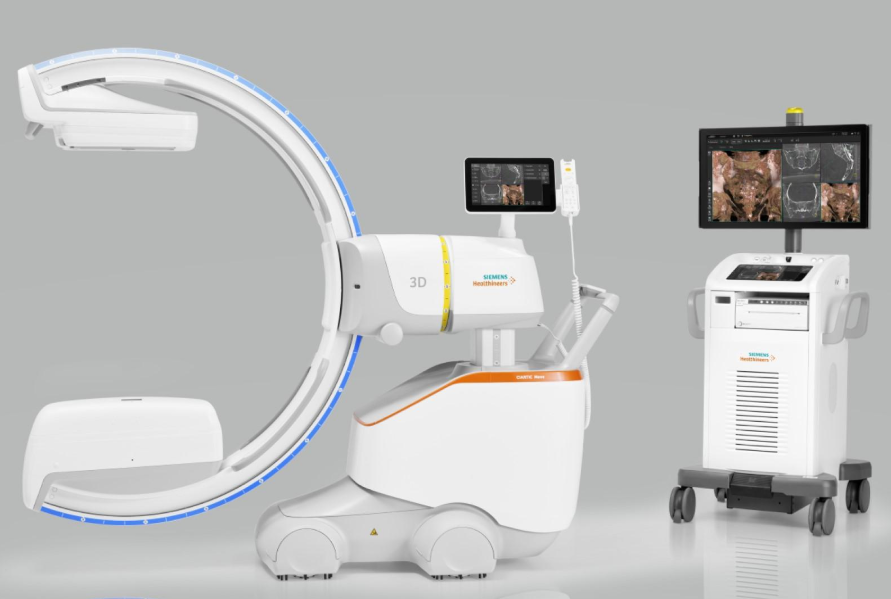
Alpine Spine & Orthopedics, a regenerative medicine clinic in Utah, has added a new C-Arm from Siemens, the Ciartic Move 3D imaging system.

Alpine reports that this system is among the most advanced of its kind, providing ultra-high-resolution 3D imaging with robotically guided movements. By using the new tech, the clinic hopes to overcome many limitations of 2D image slices during regenerative orthopedic injections.


The machine reportedly combines technologies from 3D computed tomography (CT) with 3D navigation and needle guidance, metal artifact reduction, hardware detection, high-resolution fluoroscopy, magnification, digital subtraction angiography (DSA), low-dose radiation settings, and self-driving robotic guidance with automated positioning.
You can download the datasheet for the C-arm here:
Alpine describes the Siemens 3D Ciartic Move as a low-profile mobile imaging device that enables 3D navigation with robotic holonomic mechanisms, allowing for floating-like movements around a surgical field. “This technology really moves us into the future for minimally-invasive image-guided procedures,” said Dr. Richard J. McMurtrey MD, MSc. He noted that it is considered the most advanced robotic 3D C-arm cone beam scanner for interventional procedures, providing high-resolution views of targets and approaches. The institute is reportedly the first in Utah to implement such a device.


Dr. McMurtrey is not only a physician but also holds a biomedical engineering degree from the University of Oxford, focused on regenerative medicine.
The clinic has reportedly implemented the system in numerous procedures, gaining new insights into each injury’s nuances and unique perspectives in minimally-invasive approaches. These include spinal pars defects, sacroiliac dysfunction, spino-sacral anomalies, cranio-cervical instabilities, ligament destabilization, cartilage injuries, and arthritic joint pathologies. In the first week of using the system, it reportedly enabled clear visualization of complex problems that MRI imaging could not fully clarify, such as stress fractures in the spine and non-union fractures of various bones, as well as complex bone spurs and cysts.
Dr. McMurtrey stated that the focus is on repairing underlying injuries directly with minimally-invasive image-guided procedures, allowing for the visualization and targeting of orthopedic and neurologic problems from every angle. He noted that many patients resort to steroid injections, which can weaken and degenerate cartilage, bone, ligaments, and tendons. Instead, the practice reportedly focuses on regenerative interventions to target underlying tissue injuries and pain generators.
For more information, visit Alpine Spine & Orthopedics Institute’s website at http://www.AlpineSpineOrthopedics.com and follow them on Instagram at @AlpineSpineOrthopedics.