New Trial: iPSC-Derived Exosome Therapy for Moyamoya Disease

Researchers are testing whether exosomes from stem cells can enhance blood vessel repair for Moyamoya patients after surgery.
A Phase I clinical trial led by Huaqiu Zhang at Tongji Hospital in Wuhan, China, is now recruiting participants to evaluate the safety and feasibility of a new regenerative approach for Moyamoya disease. The study is investigating exosomes derived from induced pluripotent stem cells (iPSC-EVs), in combination with temporal muscle flap surgery, as a method to promote reconstruction of intracranial and extracranial blood flow in patients who have not responded well to standard revascularization surgery.

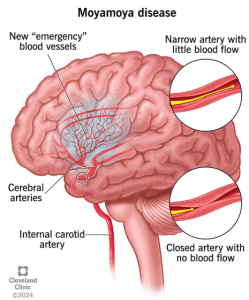
Moyamoya disease is a chronic cerebrovascular disorder characterized by progressive narrowing and occlusion of arteries at the base of the brain, leading to the development of fragile, abnormal vascular networks. This results in an increased risk of strokes, both ischemic and hemorrhagic. Current surgical approaches aim to restore blood flow, but not all patients benefit, and innovative therapies are being sought to improve outcomes.


(Image – Cleveland Clinic)

In this single-arm, open-label trial, up to nine adult patients (ages 35-65) with persistent cerebral ischemia after temporal muscle flap surgery will receive local transplantation of iPSC-EVs, supplied by iRegene Therapeutics Co., Ltd. The study design includes:

  • Administration of iPSC-EVs at the surgical site to potentially enhance angiogenesis and collateral circulation formation.
  • Monitoring and assessment at multiple time points: 3 days, 2 weeks, and 1 month post-treatment for primary outcomes, with extended follow-up to 24 months for secondary outcomes.

Researchers will primarily evaluate:

  • Safety and tolerability: Tracking adverse events and treatment-emergent effects in the short term.
  • Imaging outcomes: MRI and transcranial Doppler (TCD) before and at 1 month after iPSC-EV treatment to assess changes in cerebral blood flow.
  • Neuropsychological function: Standardized tests (mRS, MMSE, MoCA) before and at 1 month to evaluate cognitive and functional status.

Secondary outcomes include longer-term follow-up with additional imaging (DSA, CT, HR-VWI) and neuropsychological assessments at 3, 6, 12, and 24 months to track durability and function of reconstructed blood flow.

According to the researchers, iPSC-derived extracellular vesicles may offer several potential advantages:

  • Promoting vascular regeneration and enhancing collateral blood vessel formation.
  • Suppressing inflammatory responses in the brain.
  • Stable, drug-like production and potential for future genetic engineering.

The team notes that iPSC technologies are gaining attention worldwide for their regenerative and tissue-targeting capacities. Exosome-based therapies, in particular, are being explored for their ability to deliver bioactive molecules and influence cell repair processes.

The trial began in May 2025 and is expected to complete primary outcome collection by May 2026, with overall completion projected for October 2026. Once finished, investigators will report on safety, neuroimaging changes, and neuropsychological outcomes to assess whether this novel cell-free regenerative technique can support surgical treatment and recovery in Moyamoya disease patients.

Want to stay updated on regenerative medicine trials? Get the free weekly newsletter here.

If you found this post helpful, would you mind sharing it? ⬇️ 

Related:

Keck Medicine of USC is participating in a small Phase 1 clinical trial evaluating the safety and early effectiveness of implanting induced pluripotent stem cell-derived dopamine-producing cells into the brain for Parkinson’s disease.
A new kit aims to streamline 3D iPSC transfection, offering higher efficiency and lower cytotoxicity for researchers and developers.
Lineage will evaluate the new gene-edited iPSC line for immune compatibility and manufacturing potential before pursuing exclusive rights with Factor Bioscience.
The partnership aims to streamline production and quality testing of gene-edited hematopoietic stem cell therapies for HIV and rare diseases.
With the right secured for stem cell potency, Longeveron is continuing its path forward with clinical trials for several mesenchymal stem cell indications.

The Latest:

This is part of J&J's $55B investment in US manufacturing over the next few years.
The company is developing autologous cell therapies for fecal and urinary incontinence tied to weakened sphincter muscles.
ENCell's umbilical cord-derived mesenchymal stem cell therapy candidate EN001 received FDA orphan drug designation for Duchenne muscular dystrophy, marking its second designation after Charcot-Marie-Tooth disease and positioning it as a potential platform therapy for rare neuromuscular diseases.
Arizona lawmakers are advancing SB 1214, a bill that would allow certain non-FDA-approved stem cell and birth tissue therapies, with limitations.
They've completed enrollment of 99 patients across 15 U.S. sites in its Phase 2 trial evaluating BRTX-100, a mesenchymal stem cell therapy for chronic lumbar disc disease.
Zemcelpro (dorocubicel) is designed to support blood and immune system recovery after myeloablative conditioning in patients with hematologic diseases.
GwoXi’s FDA filing aims to support cell therapy and exosome developers with a standardized, traceable stem cell source.
The lipid microbubble platform aims to enhance cell therapy manufacturing, adapted from its clinically validated ultrasound imaging tech.
The company says its platform may fundamentally change how cartilage loss and degenerative joint disease is treated globally.
Based on their results in Korea/Japan, they received a Phase 3 fast track in the USA, and hope to show true cartilage regeneration. Potentially historic moment for the industry coming.
The new registry aims to address evidence gaps and track long-term outcomes for orthobiologic treatments.
Long-term follow-up suggests ProTrans may help preserve insulin production, with results varying by dose.

Discover more from Regen Report

Subscribe now to keep reading and get access to the full archive.

Continue reading

Stay updated on Regenerative Medicine