CellFiber Launches GMP-Compliant Extruder for Advanced Cell Therapy Manufacturing

The new CellFiber Extruder aims to address manufacturing bottlenecks in cell therapy by enabling scalable, GMP-compliant cell production.

Key findings

  • CellFiber has introduced a GMP-compliant manufacturing system, the CellFiber Extruder, for large-scale cell fiber fabrication.
  • It aims to streamline and standardize cell therapy manufacturing by using single-use components and compliance features that support closed processing and traceability.

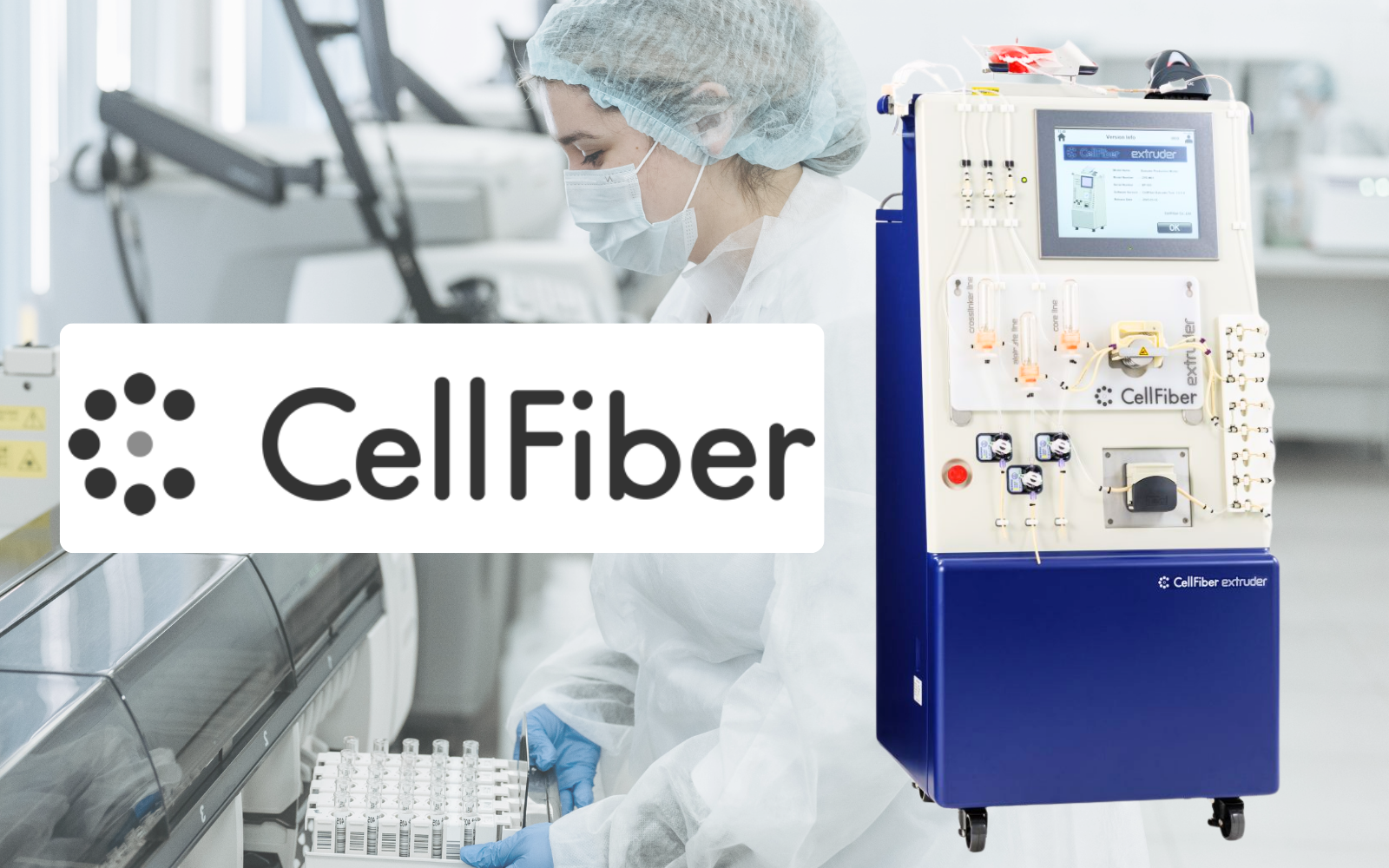
Japan’s CellFiber has introduced a production-scale model of its GMP-compliant cell fiber fabrication system, the CellFiber Extruder, designed to scale cell manufacturing for regenerative medicine and cell therapy products.

Why CellFiber is building this

The industry faces ongoing manufacturing constraints, including complex processes, long production timelines, and high costs. CellFiber designed the extruder to support larger-scale, standardized production under GMP (Good Manufacturing Practice) expectations, with a focus on stable processing and reduced manual handling.

What CellFiber technology is

It works by encapsulating cells within a tubular structure made of medical-grade alginate (a polysaccharide commonly derived from seaweed and used in biomaterials), creating a high-density cell culture environment. It’s also paired with a dedicated single-use kit and reagent set.

The company says the approach supports functional maintenance, long-term viability, and consistency compared to conventional methods.

Key features

  • Automation: Streamlines cell fiber production for large-scale cultures, with the goal of reducing manufacturing time.
  • Flexibility: Compatible with suspension and adherent cell cultures, upstream and downstream processes, and multiple types of culture vessels.
  • Closed system: Uses a single-use kit intended to reduce contamination risk from manual handling and the surrounding environment.
  • Traceability: Includes monitoring logs, access control, and audit trails intended to support regulatory requirements.

The system is designed for a 5-liter scale culture, with target yields of

  • Adherent cells: 109 cells per set
  • Suspension cells: 1010 cells per set

Product specs

  • Dimensions: W: 699 mm × D: 565 mm × H: 1380 mm
  • Weight: 128 kg
  • Power requirements: 95-125 VAC, 50/60 Hz, 200VA
  • Built-in PC OS: Windows 10
  • Connectivity: 1 USB slot, 1 Ethernet port
  • Regulatory compliance: GAMP5, 21 CFR Part 11

Single-use kit and reagent set

The single-use kit includes sterile connectors for aseptic connection with reagents, plus a final line made of compatible materials for connecting culture bags using sterile connectors. The company also notes that kits for adherent and suspension cell cultures are available.

The company added that the CellFiber Extruder Single-Use System meets USP 1043 and ISO 20399:2022, and cites ISO 11137 as a sterilization standard.

More information: https://cellfiber.jp/en/

Want to keep up on regenerative medicine? Get the weekly newsletter here.

If you found this post helpful, would you mind sharing it? ⬇️ 

Related:

This is part of J&J's $55B investment in US manufacturing over the next few years.
The company is developing autologous cell therapies for fecal and urinary incontinence tied to weakened sphincter muscles.
A new kit aims to streamline 3D iPSC transfection, offering higher efficiency and lower cytotoxicity for researchers and developers.
GwoXi’s FDA filing aims to support cell therapy and exosome developers with a standardized, traceable stem cell source.
The lipid microbubble platform aims to enhance cell therapy manufacturing, adapted from its clinically validated ultrasound imaging tech.

The Latest:

The company has emerged from stealth mode with a new $21 million Series A tranche (bringing total funding to $42 million), appointed Ron Cohen, M.D. as CEO, and reported early Phase 1b/2a Parkinson’s neuron replacement therapy data showing motor improvements
Keck Medicine of USC is participating in a small Phase 1 clinical trial evaluating the safety and early effectiveness of implanting induced pluripotent stem cell-derived dopamine-producing cells into the brain for Parkinson’s disease.
ENCell's umbilical cord-derived mesenchymal stem cell therapy candidate EN001 received FDA orphan drug designation for Duchenne muscular dystrophy, marking its second designation after Charcot-Marie-Tooth disease and positioning it as a potential platform therapy for rare neuromuscular diseases.
Arizona lawmakers are advancing SB 1214, a bill that would allow certain non-FDA-approved stem cell and birth tissue therapies, with limitations.
They've completed enrollment of 99 patients across 15 U.S. sites in its Phase 2 trial evaluating BRTX-100, a mesenchymal stem cell therapy for chronic lumbar disc disease.
Zemcelpro (dorocubicel) is designed to support blood and immune system recovery after myeloablative conditioning in patients with hematologic diseases.
The company says its platform may fundamentally change how cartilage loss and degenerative joint disease is treated globally.
Based on their results in Korea/Japan, they received a Phase 3 fast track in the USA, and hope to show true cartilage regeneration. Potentially historic moment for the industry coming.
The new registry aims to address evidence gaps and track long-term outcomes for orthobiologic treatments.
Lineage will evaluate the new gene-edited iPSC line for immune compatibility and manufacturing potential before pursuing exclusive rights with Factor Bioscience.
Long-term follow-up suggests ProTrans may help preserve insulin production, with results varying by dose.
The collaboration will assess whether robotic automation can help scale up cell therapy manufacturing while maintaining GMP standards.

Discover more from Regen Report

Subscribe now to keep reading and get access to the full archive.

Continue reading

Stay updated on Regenerative Medicine