
Ernexa Therapeutics Reports Positive Preclinical iPSC-Derived Mesenchymal Stem Cell Study, Advances Oncology Strategy
In mice with collagen-induced arthritis, several ERNA-201 candidates lowered disease severity versus untreated controls, while the company shifts near-term spending to ERNA-101’s planned ovarian cancer trial filing.
Key Points
- Preclinical ERNA-201 candidates reduced disease severity in the collagen-induced arthritis mouse model compared with untreated controls.
- Ernexa is pausing additional near-term preclinical spending on ERNA-201 while prioritizing ERNA-101 and its planned FDA IND submission in Q4 2026 for platinum-resistant ovarian cancer.
- The company said the ERNA-201 data support the broader use of its induced mesenchymal stem cell (iMSC) platform across multiple disease settings.
Ernexa Therapeutics reported positive preliminary preclinical results for ERNA-201, its synthetic, allogeneic (donor derived) induced mesenchymal stem cell (iMSC) therapy engineered to express anti-inflammatory factors, and said it is sharpening its oncology strategy around ERNA-101.


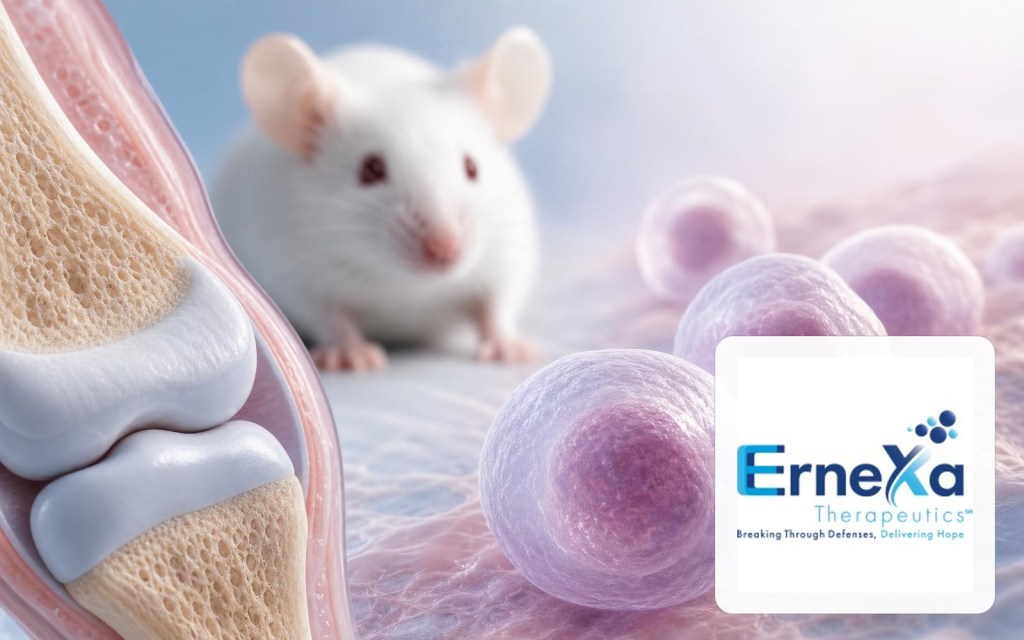
In studies using the collagen-induced arthritis model, several ERNA-201 lead candidates demonstrated reductions in disease severity relative to untreated controls, including improvements in clinical arthritis scores consistent with the therapy’s intended anti-inflammatory mechanism of action.
The company said the findings provide preclinical proof of concept in inflammatory disease and support the broader versatility of its engineered iMSC platform.
With those data in hand, Ernexa said it is concentrating near-term capital and operational resources on advancing ERNA-101 into a first-in-human clinical study in platinum-resistant ovarian cancer.
“We believe the ERNA-201 results are an important validation of both the program and the broader potential of our synthetic iMSC platform,” said Sanjeev Luther, President and Chief Executive Officer of Ernexa Therapeutics. “ERNA-201 did what we wanted to see at this stage: it generated an encouraging proof-of-concept signal in an established inflammatory disease model and demonstrated the potential to engineer our iMSCs for therapeutic activity beyond cancer. That success gives us the confidence to preserve the significant future opportunity represented by ERNA-201 while concentrating our resources on the milestone directly ahead of us, bringing ERNA-101 into the clinic.”
Mr. Luther continued, “Our objective is bigger than advancing a single candidate. We are building a differentiated oncology company around a scalable, off-the-shelf cell therapy platform. With ERNA-101 on track for FDA IND submission before year end, we believe Ernexa is approaching a potentially defining inflection point. We intend to execute against that milestone with urgency while broadening our oncology pipeline and identifying additional cancers where our platform could make a meaningful difference.”
ERNA-201 Preclinical Findings
ERNA-201 is engineered to express anti-inflammatory factors designed to target inflammation and treat autoimmune disease. In completed preliminary studies, ERNA-201 was evaluated in the collagen-induced arthritis model, which is widely used to assess potential therapies for rheumatoid arthritis and other inflammatory joint diseases.
Mice treated with several ERNA-201 lead candidates demonstrated reductions in disease severity relative to untreated controls, including improvements in clinical arthritis scores. Ernexa said the findings are consistent with the candidate’s intended anti-inflammatory mechanism and support the use of synthetic, cytokine-engineered iMSCs in inflammatory and autoimmune disease.
“Seeing disease-modifying activity from ERNA-201 in the collagen-induced arthritis model is an encouraging scientific result,” said Robert H. Pierce, M.D., Chief Scientific Officer of Ernexa Therapeutics. “These findings support the underlying thesis that engineered iMSCs can serve as a versatile therapeutic delivery platform. We designed ERNA-201 to deliver anti-inflammatory factors in disease, and the preliminary activity we observed is consistent with that objective. From a scientific perspective, these data increase our confidence in the program and provide another important validation point for the broader platform.”
Ernexa noted that ERNA-201 uses the same core synthetic iMSC platform architecture as the rest of its pipeline. While ERNA-201 is designed for anti-inflammatory activity and ERNA-101 is designed to stimulate an immune response against cancer, the company said both programs illustrate how an allogeneic (donor derived), scalable cell platform may be engineered for distinct therapeutic purposes.
Oncology Prioritization and Near-Term Milestones
Ernexa said it is prioritizing ERNA-101, its lead oncology cell therapy candidate, toward a planned FDA IND submission in the fourth quarter of 2026 for a first-in-human clinical study in platinum-resistant ovarian cancer.
ERNA-101 is engineered to express an IL-7/IL-15 fusion cytokine designed to activate and regulate the immune system’s response to recognize and attack cancer cells.
The company said clinical data from the ERNA-101 platinum-resistant ovarian cancer program are expected in Q4 2027.
Ernexa also said it has elected to pause additional preclinical development expenditures on ERNA-201 for now while preserving the program and directing near-term resources toward ERNA-101 and broader oncology pipeline expansion.
“We have achieved an important objective with ERNA-201 by generating encouraging proof-of-concept data,” Luther said. “The question for us now is not whether we believe in the program. We do. The question is where each incremental dollar and each hour of our team’s effort can have the greatest impact today. With ERNA-101 approaching the clinic, we believe concentrating resources behind first-patient dosing and expanding our oncology opportunity is the most disciplined path forward.”
The company outlined the following planned milestones over the coming 12 to 18 months:
- Submit ERNA-101 IND in Q4 2026 for a first-in-human clinical study in platinum-resistant ovarian cancer
- Generate clinical data from the ERNA-101 program, currently expected in Q4 2027
- Continue generating translational and preclinical evidence to support the synthetic iMSC platform
- Evaluate expansion into additional high-need oncology indications
- Advance next-generation synthetic iMSC oncology candidates
- Explore strategic collaborations that could broaden the application of the platform
“We are preserving ERNA-201’s future potential while accelerating the program that is closest to human clinical validation. We believe that the combination of scientific validation, disciplined execution and a clear path into the clinic positions Ernexa for an important next chapter.”
Ernexa’s platform begins with induced pluripotent stem cells (iPSCs), which are engineered and transformed into synthetic induced mesenchymal stem cells. The resulting allogeneic (donor derived) iMSCs are intended to provide an off-the-shelf therapeutic approach without patient-specific cell harvesting.
More information is available at ernexatx.com.
Want to keep up on regenerative medicine? Get the weekly newsletter here.