Exogenus Therapeutics Leads €13M Consortium to Advance Umbilical Cord Blood Secretome Therapy for Osteoarthritis
A planned first-in-human Phase 1b trial of the umbilical cord blood-derived candidate EXO-101 in patients with moderate osteoarthritis is expected to begin in early 2028.
Key Points
- Exogenus Therapeutics is leading a five-year, €13 million EU-funded consortium to advance an extracellular vesicle-enriched secretome therapy for osteoarthritis.
- The project will support Phase I and II clinical development of Exogenus’ lead candidate, EXO-101, while addressing manufacturing and regulatory barriers across the secretome therapeutics field.
- First-in-human Phase 1b studies of EXO-101 in patients with moderate osteoarthritis are expected to start in early 2028.
The ExoCordOA consortium has launched a five-year, €13 million project, funded by Horizon Europe, to advance extracellular vesicle-enriched secretome therapies toward clinical use, with an initial focus on osteoarthritis. Led by Exogenus Therapeutics, a developer of biologics for regenerative medicine indications, the consortium brings together ten organizations with expertise across biotechnology, clinical and regulatory development, GMP manufacturing, medical imaging, academia, and healthcare.
Stay updated on Cell & Gene news
Thanks! Your signup has been saved.
A central objective is to advance Exogenus’ lead candidate, EXO-101, toward clinical validation as a potential disease-modifying treatment for osteoarthritis. The programme will support the candidate’s Phase I and II clinical development while also addressing scientific, manufacturing, quality-control, and regulatory challenges that currently limit the clinical translation of extracellular vesicle and secretome therapies. The consortium aims to resolve systemic bottlenecks by helping to develop more standardised approaches, robust analytical and potency assessment methods, and a clearer regulatory pathway for future secretome-based medicines.
Joana Correia, PhD, Co-Founder and Chief Executive Officer of Exogenus Therapeutics, said: “ExoCordOA brings together the expertise needed not only to advance EXO-101 towards clinical validation in osteoarthritis, but also to tackle barriers affecting the wider secretome therapeutics field. As project coordinator, Exogenus is proud to lead this collaborative European effort to establish stronger scientific, manufacturing and regulatory foundations for a new generation of regenerative medicines.”
The project forms part of a wider European effort to accelerate the clinical translation, standardisation, and regulatory development of secretome-based therapies. The European Commission’s dedicated Horizon Europe funding call reflects the strategic importance it places on this emerging field and on building European innovation and leadership in advanced regenerative and anti-inflammatory therapeutics.
The ExoCordOA consortium is coordinated by Exogenus Therapeutics and comprises Lonza, Anthony Nolan, Eliquent Life Sciences, iLoF – Intelligent Lab on Fiber, Utrecht University, University Medical Center Utrecht, Maastricht University Medical Center+, Image Analysis Group, and ReumaNederland.
EXO-101
EXO-101 is derived from native, non-engineered umbilical cord blood cells and contains proteins, microRNAs, and lipids that the company says are designed to act across multiple disease pathways, support joint health, and delay the need for replacement. The candidate is produced using a standardised, scalable, and GMP-compatible manufacturing process. First-in-human Phase 1b studies in patients with moderate osteoarthritis are expected to start in early 2028.
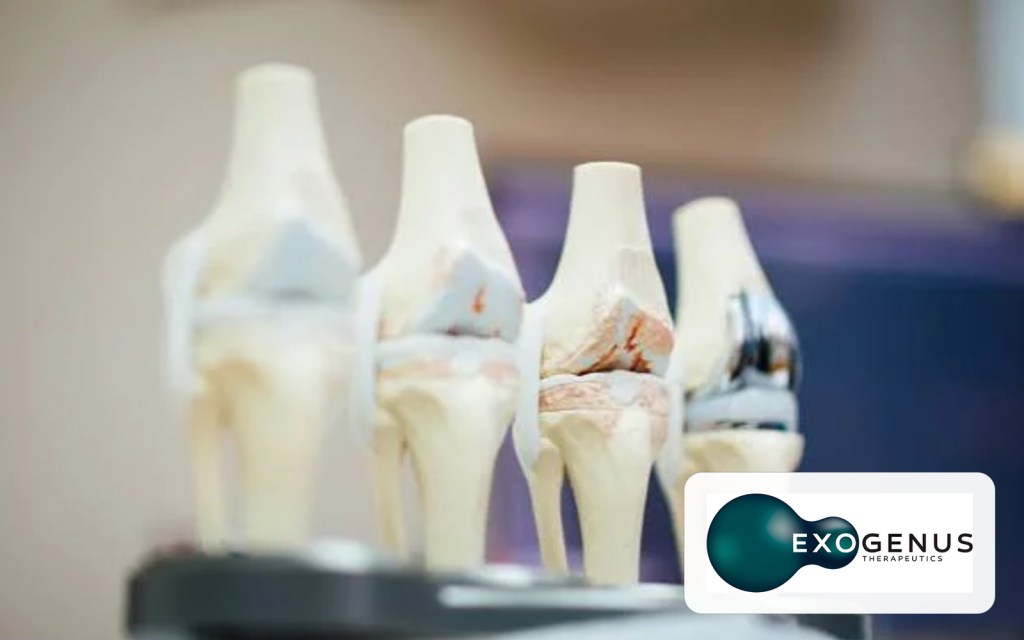
Osteoarthritis is a leading cause of disability worldwide. It affects approximately 8% of the global population, primarily women, with prevalence expected to rise as populations age. No approved disease-modifying osteoarthritis drugs are currently available, leaving patients reliant on symptom management and, ultimately, joint replacement. As a potential disease-modifying therapy, EXO-101 could slow or prevent disease progression, address a significant unmet need, and reduce reliance on invasive surgery, according to the company.
EXO-101’s second EU-funded programme, EXO-OTOProtect, targets platinum-chemotherapy-induced hearing loss, an irreversible, dose-limiting toxicity affecting 50–60% of treated patients. At preclinical proof-of-concept stage, the candidate is designed to preserve cochlear outer hair cells and tackle the multiple pathological pathways underlying ototoxic injury. Beyond these lead indications, EXO-101 has shown early proof-of-concept in lung fibrosis and in broader liver and renal fibrosis programmes, which remain in internal development.
Want to keep up on regenerative medicine? Get the weekly newsletter here.
Similar stories
 Shanghai Jiao Tong University School of Medicine Tests Intranasal Umbilical Cord Exosomes for Early Parkinson’s Disease
 Porton Advanced Announces FDA Acceptance of Drug Master File for Umbilical Cord Stem Cell-Derived Exosomes
 New Trial – Mesenchymal Stem Cell Exosomes for Non-Dialysis Chronic Kidney Disease
 NurExone and NanoPass Developing Stem Cell Exosomes for Eye and Skin Regeneration
 Celularity to Manufacture MuseCell Innovations Therapies in the US
 Made Scientific Acquires Resilience’s 85K-Square-Foot Cell Therapy Facility
 Kincell Bio and Cellipont Bioservices Merge to Form Kincellis Advanced Therapies
 Mesenchymal Stem Cell Extracellular Vesicles Reprogram Microglia and Prevent Neurodegeneration in Alzheimer’s Models