Altman-Backed Regenerative Medicine Startup, Retro Biosciences, Closes Funding Round at $1.8B Valuation
The company is working on iPSC-derived, AAV, and small molecule therapies for neurodegenerative, orthopedic, and blood-based disorders, with the help of OpenAI's models which seem to be accelerating life science research.
Key Points
- Retro Biosciences has announced the initial close of its next financing round at a $1.8 billion pre-money valuation.
- The company has rapidly moved its Alzheimer’s candidate, RTR242, into Phase I, with several other therapies in the pipeline.
Retro Biosciences, a longevity startup backed by Sam Altman, has closed its next financing round at a pre-money valuation of $1.8 billion. The company is working on regenerative therapies with the stated goal of adding 10 years of healthy lifespan to humans by targeting mechanisms tied to aging and age-related disease.

They have a handful of therapies in the pipeline, ranging from induced pluripotent stem cell-derived (iPSC), small molecules, and gene therapy.
- RTR242 (Phase 1) – Small molecule drug to boost autophagic flux (autophagic flux is the body’s cellular trash and recycling system)
- iMG (Preclinical) – iPSC-derived microglial progenitors (precursors to the brain’s immune cells)
- iHSC (Preclinical) – iPSC-derived hematopoietic (blood) stem cells
- Tissue Reprogramming (Proof-of-concept) – AAV-delivered (adeno-associated virus, a small virus which delivers a gene therapy) reprogramming factors for osteoarthritis and hearing loss
In March 2023, the small startup made headlines after it announced a $180M investment from Sam Altman, then shortly after, we caught a peek at where this is going:
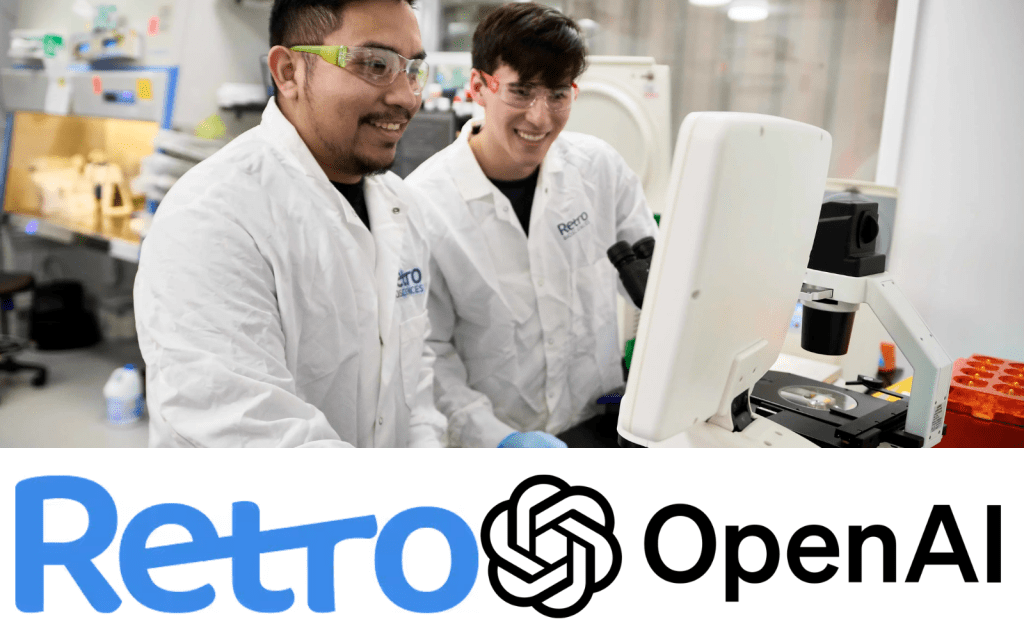
In August of 2025, Retro Biosciences announced it was working with OpenAI to apply OpenAI’s GPT-4b large language model for iPSC research. They mentioned they had successfully leveraged it to design “novel and significantly enhanced variants of the Yamanaka factors, a set of proteins which led to a Nobel Prize for their role in generating induced pluripotent stem cells (iPSCs) and rejuvenating cells,” and these proteins “achieved greater than a 50-fold higher expression of stem cell reprogramming markers than wild-type controls”.
Following that, Retro announced it was launching its Phase 1 RTR242 trial focused on small molecules for Alzheimer’s. As people age, lysosomes (the cell’s garbage disposal/recycling centers) tend to lose some of their acidity, and thus their efficiency. This seems to cause a buildup of toxic proteins around neurons, which can contribute to their dysfunction and eventual loss, reports Longevity Technology. The goal with RTR242 is to repair this cellular function, hopefully preventing or mitigating Alzheimer’s.
They also mention having an in-house cGMP cell therapy manufacturing facility. Between that and premier access to OpenAI models and funding, they were able to move pretty rapidly… from first lab to clinical candidate took about 3 years, and from selecting the indication to first-in-human dosing was about 15 months.
With the new capital in hand, they said they’re continuing to develop the above programs and investing in new discovery efforts. The broader goal, according to the company, is to build a repeatable process for translating aging biology into medicines rather than advancing only a small number of standalone programs.
Context from Other Industries
It’s interesting to see AI partnerships progress in the stem cell industry. I’ve also worked in the electric vehicle media industry for about a decade, and a few years ago, I gave a presentation on battery companies partnering with AI companies, and how rapidly they’re able research problems now. Microsoft reported that in one experiment, they whittled down 20 years of work into about 80 hours.
Similar to biotechnology, of course, this is only proof-of-concept lab work and will take several years until (if ever) this hits the real world, but it’s fascinating to see just how rapidly researchers are able to tackle challenges with the new tool in the shed.
Want to keep up on regenerative medicine? Get the weekly newsletter here.