UniXell Biotechnology Nabs IND Clearance for its iPSC Parkinsons Therapy, UX-DA003
The Chinese company also received an IND in China a few weeks ago. Supported by good preclinical data, they'll advance clinical trials in both countries soon.
Key Points
- UniXell Biotechnology has received FDA IND clearance for UX-DA003, its allogeneic induced pluripotent stem cell (iPSC)-derived Parkinson’s disease therapy.
- The clearance follows an earlier IND approval from China’s NMPA, allowing UniXell to advance UX-DA003 in both the U.S. and China.
- UniXell says UX-DA003 is supported by preclinical data on cell purity, dosing, and long-term safety, and is part of a broader Parkinson’s pipeline that also includes the autologous (sourced from the patient) candidate UX-DA001.
UniXell Biotechnology, a Chinese cell therapy company, has secured FDA IND clearance for UX-DA003, its allogeneic (donor derived) iPSC-derived therapy for Parkinson’s. The decision follows an earlier IND approval from China’s NMPA on June 3, 2026, and allows the company to move the program into clinical development in both countries.
Stay Ahead in Regenerative Medicine
Thanks! Please confirm your email using the link we sent from Jeremy@RegenReport.com (check spam too please).
Their site is hard to access, but with a handy Taiwanese VPN, here’s what I found:
UX-DA003 appears to be a midbrain dopaminergic progenitor cell therapy, built on its SISBAR lineage tracing platform, a directed differentiation system, and a GMP-compliant iPSC seed cell bank. SISBAR is described as “a new lineage tracing technology combining viral barcoding, single-cell RNA sequencing and clonal strategies, and has been established to perform complete lineage tracing spanning multiple developmental stages”.
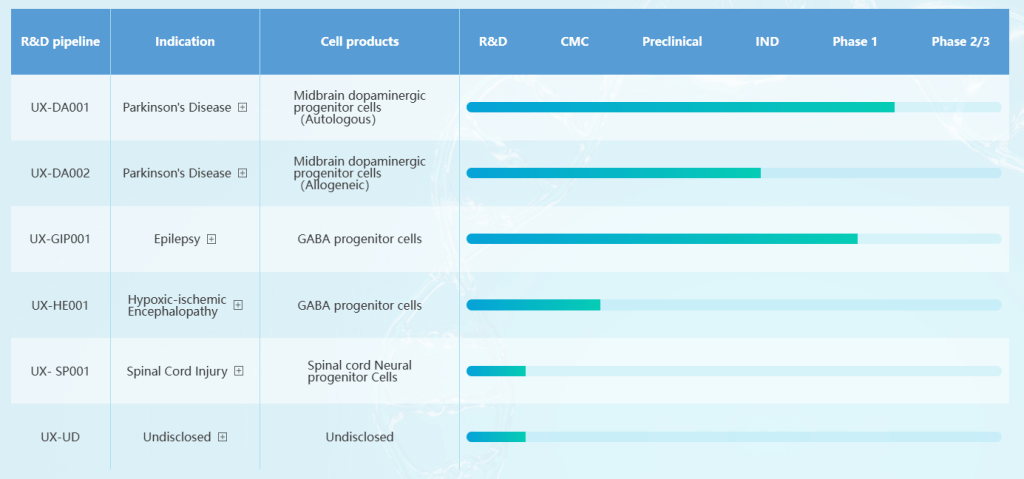
Here’s a snapshot of their pipeline:
Preclinical profile and manufacturing claims
According to the company, preclinical data for UX-DA003 showed:
- Functional dopaminergic neurons accounting for 50 to 60% of cells in grafts
- A projected 50 to 80% reduction in required clinical dose compared with conventional cell therapy regimens, based on higher cell purity
- A 0.23% proliferating cell rate at six months after transplantation, compared with a reported range of 0.5 to 11%
UniXell says these findings support the candidate’s safety, manufacturability, and suitability for standardized large-scale clinical use in Parkinson’s disease. Those remain subject to clinical validation.
Broader Parkinson’s strategy
UniXell is developing Parkinson’s therapies through two routes. UX-DA001 is an autologous (sourced from the patient) iPSC therapy now in a Phase I trial at Ruijin Hospital in Shanghai. The company says the first enrolled patient has completed one year of follow-up and that early results showed a favorable safety profile.
UX-DA003 is the company’s allogeneic (donor derived) counterpart, which if validated, could support larger-scale production, lower cost, and broader access.
UniXell also said its regulatory submissions in China and the U.S. use a shared iPSC seed cell platform and standardized manufacturing processes, which the company believes will support broader global development of its allogeneic cell therapy pipeline.
Want to keep up on regenerative medicine? Get the weekly newsletter here.
Similar stories
 Encellin and Breakthrough T1D Planning Phase 1 of Immune-Protected Cell Therapy for Type 1 Diabetes
 Webinar: Scaling iPSC Therapies Without Scaling Variability
 Aspen Neuroscience Publishes Preclinical Data on Parkinson’s iPSC-Derived Cell Therapy
 Made Scientific Acquires Resilience’s 85K-Square-Foot Cell Therapy Facility
Editor’s Picks
 Century Therapeutics Reports Sustained Glucose Control With iPSC-Derived Islets in Diabetic Mice, IND Soon
 Umbilical Cord Mesenchymal Stem Cell Injections Lower Pain Scores More Than Hyaluronate in 50-Patient Severe Knee Osteoarthritis Trial
 Stempeutics Nabs US Patent for Osteoarthritis Treatment Combining Bone Marrow Stem Cells and Hyaluronic Acid
 Novadip Secures €10.4M for Pivotal Phase 3 Bone Repair Cell Therapy Trial