Replacing Magnetic Separation with Buoyancy: A Closer Look at Bracco’s New Cell Selection Platform, BubbleGen™
Could a gentler, more scalable method improve how cells are isolated for advanced therapies? We spoke with Bracco’s Sophie He about the early data, manufacturing potential, and challenges ahead.

Regen Report: Bracco, a company best known for microbubble-based ultrasound contrast agents, has found a new application for its bubbles: cell therapy manufacturing.
Today, most cell therapy developers rely on Magnetic Activated Cell Sorting (MACS) to isolate target cell populations. While effective, these systems can introduce workflow complexity, create challenges when working with rare or fragile cells, and may be difficult to automate and scale as manufacturing volumes increase.
Stay Ahead in Regenerative Medicine
Thanks! Please confirm your email using the link we sent from Jeremy@RegenReport.com (check spam too please).
Bracco’s new BubbleGen™ technology takes a different approach. Instead of pulling cells through a magnetic field, the target cells attach to buoyant microbubbles and simply float to the surface. According to Bracco, the technology may offer advantages in automation, sequential selection, workflow simplicity, and scalability, particularly with rare cell populations.
We sat down with Sophie He, PhD, CFA, FRM, Vice President of Cell Therapy at Bracco, to discuss how BubbleGen works, the early data generated, first industry reactions, and what it could mean for the future of scaling cell therapies.
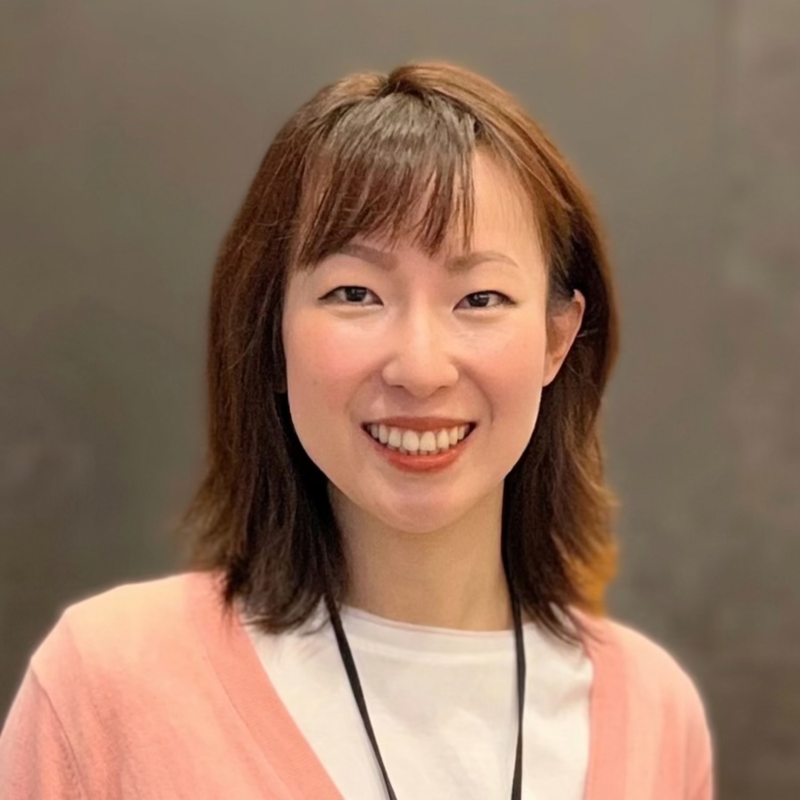
Can you introduce Bracco’s microbubbles, and where the idea of cell manufacturing came from?
Sophie: Bracco’s microbubbles are gas-core, lipid-shell structures, and because gas reflects ultrasound waves differently from surrounding tissue, clinicians can use them with ultrasound to visualize blood flow and tissue perfusion in real time.

However, the team likes to call the microbubbles the “Swiss knife” because of their versatility beyond imaging. For the past several years, Bracco has been investigating whether their physical properties, such as buoyancy and cavitation, can be leveraged for cell therapy manufacturing.
While the team was exploring that possibility, a researcher approached us looking for an alternative solution for cell selection.
The team iterated on dozens of combinations of gas formulations, lipids, targeting tags, and surface chemistries to optimize the platform, and eventually we arrived at a workable solution: BubbleGen.
What’s wrong with Magnetic-Activated Cell Sorting (MACS)?
Sophie: Magnetic beads have long been the dominant cell-selection technology, working well for both positive and negative selection. However, it has several limitations that become more apparent when working with rare cell populations or cells defined by multiple markers. While MACS sequential selection is theoretically possible, it adds complexity and can be difficult to execute, especially at scale.
Some of the biggest challenges with MACS are:
1 – Residuals: There can be residual iron material, which creates problems for downstream processes such as electroporation.
2 – Shear stress: Strong magnets can create friction and stress on the cells, leading to concerns about performance and viability, especially with fragile cell types.
3 – Workflow: Typically, this requires columns or dedicated instruments, which may not fit into the newer end-to-end manufacturing workflows.
4 – Sequential selection and rare cell populations: Isolating cells using multiple markers often requires multiple rounds of labeling and selection. Each additional step adds complexity, increases processing time, and can reduce overall recovery. These losses become particularly problematic when the target cells represent only a very small fraction of the starting sample.
Labs have tried to overcome these with Fluorescence-Activated Cell Sorting (FACS), but its low throughput makes it difficult to scale for mass manufacturing.
These are the challenges we’re hoping to tackle with BubbleGen.
How does it work? Can you walk through the technical details?
Sophie: Let’s begin with the solution itself. It comes lyophilized as a white “cake” at the bottom of a glass vial, and the headspace contains the gas that forms the microbubbles. The lyophilized solution remains stable for 3 years at 5°C.
What’s interesting is that when reconstituted, the liquid appears milky, indicating the bubbles are present. When they dissolve, the liquid becomes translucent. This makes visual inspection very simple.

Each formed microbubble consists of an inert gas core surrounded by a single phospholipid shell that’s about 95% similar to the cell membrane, thereby reducing immunogenicity. We use an inert gas so that any residual gas does not interact with the body after administration.
Fortunately for us, the human safety of similar microbubbles is well established after decades of use in ultrasound. Once the bubbles dissolve in the body, the gas is simply exhaled.
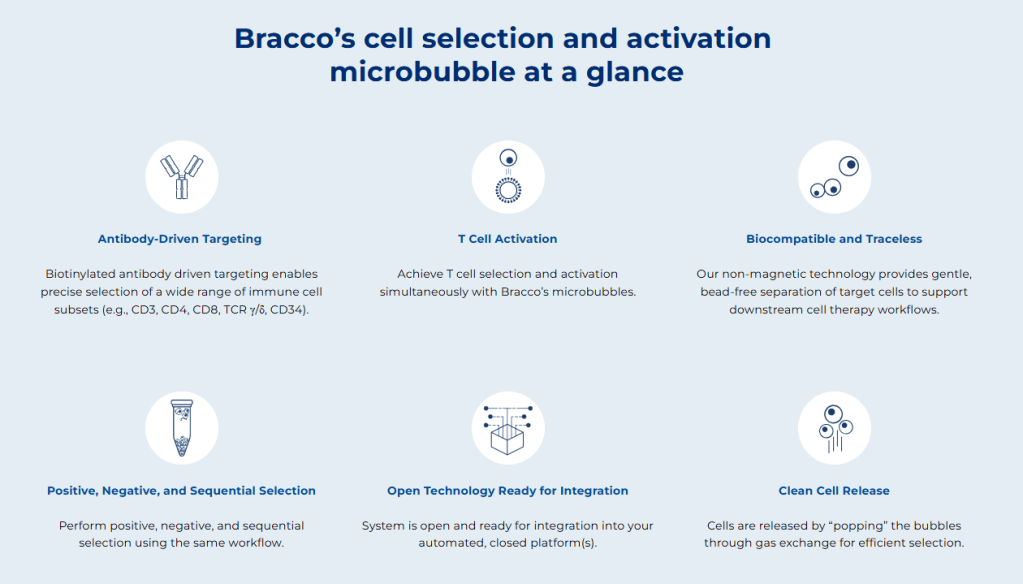
For our cell therapy microbubble, the surface is coated with streptavidin, enabling it to bind biotinylated antibodies via a streptavidin-biotin interaction. Those antibodies can then be used to target specific cell populations.

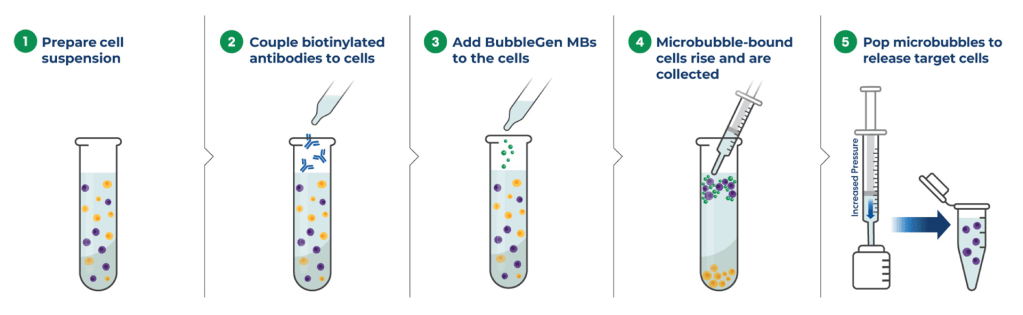
The selection workflow begins with a cell suspension. First, biotinylated antibodies are added to label the target cells. After incubation, the BubbleGen microbubbles are introduced and bind to those antibodies, effectively attaching the bubbles to the targeted cells. Following the second incubation step, the bubble-bound cells are ready for separation.
Once bound, the bubble-tagged cells naturally float to the surface due to buoyancy. From there, it’s a straightforward process: collecting the supernatant for positive selection or the bottom layer for negative.
What sort of incubation time is needed?
Sophie: We’ve manually tested this, and the answer is that it depends on the workflow. Whether you use an enclosed system, centrifugation, or apply pressure, these variables can affect the timing.
Generally, antibody incubation takes about 20 minutes, followed by another 20 minutes for bubble incubation. With centrifugation, you can reduce the time to 2-5 minutes before the supernatant is ready.
The bubbles naturally dissolve over time as gas slowly diffuses across the lipid shell, causing them to break apart in about 2 to 3 hours. However, this can be dramatically accelerated by applying about 2.5 to 3x atmospheric pressure, speeding the process up to just a few seconds.
Right away, this process comes with many advantages over MACS. For one, there’s no magnetic residue. You typically wash cells in culture anyway, and after a couple of washes, any residual lipid is gone.
Additionally, this process is much gentler. When you drag cells with a magnetic field, the acceleration can create shear stress, which is an issue for fragile cells. With BubbleGen, they gently rise to the top.
Beyond cell selection, are there any other advantages to the platform?
Sophie: Yes, some cell therapies, like CAR-T, require activation, which adds another step to the workflow. We have a proof of concept demonstrating that BubbleGen can perform cell selection and activation simultaneously, and are currently gathering data to confirm this.
For example, in T-cell workflows, CD3 and CD28 antibodies can be introduced during the initial incubation step. When the microbubbles are added, the target cells are selected while also receiving the activation signals needed for downstream processing.
In essence, this combines what would traditionally be separate selection and activation steps into a single workflow, potentially simplifying the process.
Which cell types are working best so far?
Sophie: The application is still relatively novel, and we’ve only tested with a handful of suspension cell types, so I can’t say with certainty yet.
So far, here’s what we’ve found from those tests:
- Standard T cells tagged with CD3, CD4, and CD8 have all worked well.
- CD34-positive stem cells, which are pretty rare in the population, usually less than 5%, sometimes lower, are showing pretty good recovery and purity results.
- Gamma delta T cells, another rare cell type at around 3% or less, work very well too.
- Our sequential selection runs have performed very well. For example, CD4-positive followed by CD184-positive cells, a rare dual-positive type, has been successful.
Do you have any numbers comparing cell purity, recovery, and viability with traditional methods?
Sophie: Recently at ISCT Dublin, we released data with six donors: three frozen and three fresh LeukoPaks. You can download the posters we presented at these links:
Poster 1 – One Platform, Many Targets, Transforming Cell Selection and Activation Using Lipid-Based Microbubble Poster 2 – Modular Microbubble Reagent: Efficient and Simultaneous Cell Selection and ActivationIn the smaller-scale run with 5 million starting cells, we achieved 98% recovery. In the larger run, using one-tenth of a LeukoPak, close to one billion cells, the recovery was more than 93%.

We also ran comparative tests of BubbleGen vs MACS (Miltenyi). On a like-for-like basis, with three donors and about 10 million starting cells, we achieved either similar or superior recovery.
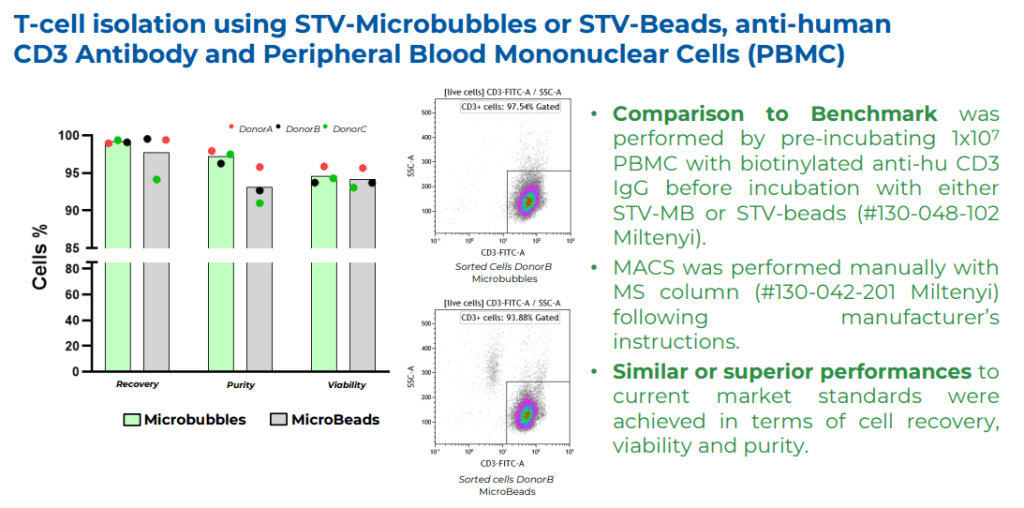
That said, it’s important to note that we’ve only done a small number of runs, so it’s difficult to definitively claim exact numbers yet. We need more data to prove the robustness of the performance. In general, the results have been comparable.
What problems do you anticipate when moving from small-scale production to liter-based, GMP-level production?
Stay Ahead in Regenerative Medicine
Thanks! Please confirm your email using the link we sent from Jeremy@RegenReport.com (check spam too please).
Sophie: Every scale-up has its own unique optimization work because each device, workflow, and manufacturing environment behaves differently. Mixing conditions, processing times, and other parameters will all need to be fine-tuned. Based on the work so far, we do not anticipate major technical barriers, but we are in collaboration with device manufacturers to optimize at larger scales.
From a physical standpoint, flotation is relatively straightforward compared with magnets. As production volumes increase, MACS often requires larger magnets, additional hardware, and more complex workflows. Flotation is intrinsically scalable: if something floats in small volumes, the same principle applies in larger volumes, so, theoretically, it could be much easier to automate in GMP-level manufacturing.
Our goal is to develop BubbleGen as a reagent-based platform rather than a standalone device. Instead of requiring manufacturers to purchase additional equipment, the idea is to integrate the technology into existing workflows and platforms without increasing the footprint.
However, it’s still too early to give a clear answer on what lies ahead.
What’s the industry feedback so far?
Sophie: We have a handful of early adopters currently testing it, but it’s too soon to share specifics. I can speak to the feedback during our live demo at ISCT, which created a lot of industry buzz.
We had many “wow” moments when people could watch, in real time, the lyophilized material reconstitute into a milky suspension and then turn translucent as the bubbles rapidly dissolved under pressure.
We’re taking applications from more early adopters; you can apply at this page.
As these early-adopter projects progress, we hope to generate meaningful data for the field and will share it as soon as possible, so stay tuned for that.
Regen Report: Special thanks to Sophie for the interview!
Similar stories
 Inside Cellular Intelligence: The Zuck-Backed AI Company That Acquired Novo’s Parkinson’s Cell Therapy
 I Peace Wins Top 10 Longevity Breakthrough Award for Cell-Free Stem Cell Technology
 Encellin and Breakthrough T1D Planning Phase 1 of Immune-Protected Cell Therapy for Type 1 Diabetes
 Webinar: Scaling iPSC Therapies Without Scaling Variability
Editor’s Picks
 Century Therapeutics Reports Sustained Glucose Control With iPSC-Derived Islets in Diabetic Mice, IND Soon
 Umbilical Cord Mesenchymal Stem Cell Injections Lower Pain Scores More Than Hyaluronate in 50-Patient Severe Knee Osteoarthritis Trial
 Stempeutics Nabs US Patent for Osteoarthritis Treatment Combining Bone Marrow Stem Cells and Hyaluronic Acid
 Aspen Neuroscience Publishes Preclinical Data on Parkinson’s iPSC-Derived Cell Therapy