Interview: From Zero to One, How Terumo’s Ecosystem Blueprint Is Helping Scale Cell Therapies in Asia
Cell and gene therapies are advancing quickly, but the systems needed to deliver them at scale are still lagging behind. Terumo’s new Ecosystem Blueprint aims to bridge that gap in Asia-Pacific by integrating workflows, equipment, and training into a coordinated model to move from isolated innovation to repeatable, real-world delivery.
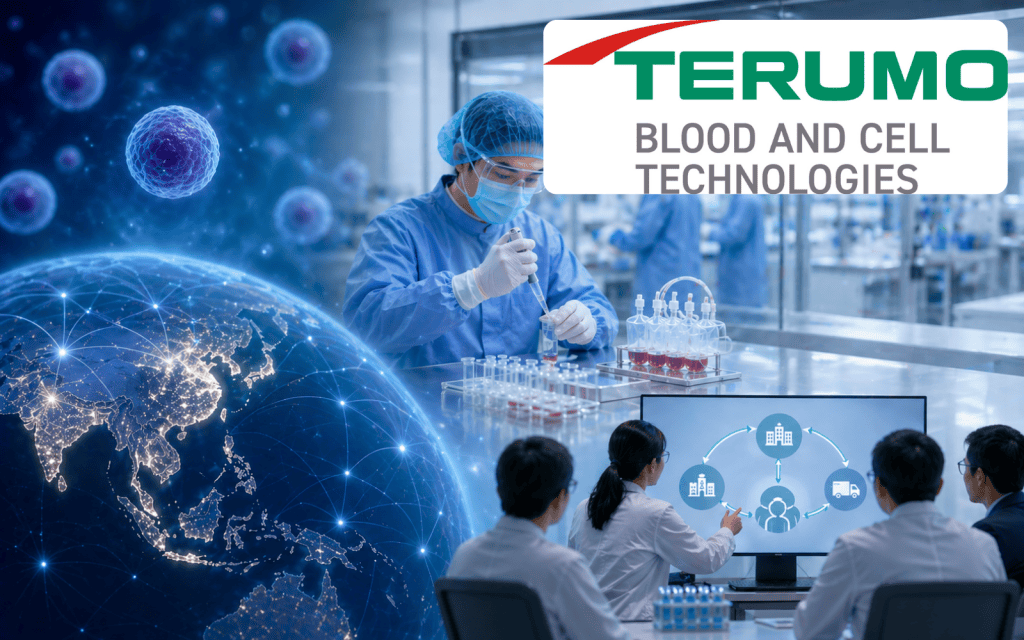
Cell therapy has entered a challenging phase: the science is increasingly real, but the systems needed to deliver it are still catching up. That gap is especially visible in Asia-Pacific, where one region can contain world-class biotech hubs, emerging hospital networks, and markets where advanced therapies remain largely out of reach.
Terumo Blood and Cell Technologies is now trying to address that foundational problem through its new C> Ecosystem Blueprint.
Stay Ahead in Regenerative Medicine
Thanks! Please confirm your email using the link we sent from Jeremy@RegenReport.com (check spam too please).
We spoke with Wenyan Leong, Ph.D., who leads Terumo’s APAC Commercial and Global Strategic Partnerships, about the “zero to one” problem in cell therapy, why delivery may matter as much as innovation, and what it will take to make advanced therapies scalable across the region.
Cell & gene therapies show great promise, but what’s preventing them from reaching the bedside?
Wenyan: As of early 2026, most countries see the potential of cell therapies but struggle to move from early development to scalable, repeatable delivery; what we call “zero to one.”
In the US, despite FDA-approved CAR-T therapies (engineered immune cells used to treat cancer), access remains limited due to the availability of centers, cost, logistics, reimbursement, and referral pathways. In other countries like Indonesia, even if you have all the money in the world, it’s likely not available at all.

“Why?” is a complex question, but there are many key drivers, ranging from macroeconomics to manufacturing, and in the Asia-Pacific (APAC), these problems are magnified by our diversity and fragmentation. For example, Singapore’s GDP per capita is 30-40 times higher than Cambodia’s, but Singapore has a small population of about 5 million people. This makes it a challenge for cell & gene developers because there’s a scarcity of clinical trial subjects, and less incentive to secure approval and license their therapies.
Each culture is different, and every government operates under its own unique regulatory and reimbursement framework. Those were designed around repeatable, centralized manufacturing, which works well for traditional pharmaceuticals, but we’re finding it doesn’t translate to regenerative medicine for many reasons, including:
- Inherent Variability: You will undoubtedly find inconsistencies across manufacturing, logistics, and even patient response, especially in these early days. It’s difficult to create a system around variable outcomes.
- Workforce: Senior scientists with specific industry experience are a local rarity.
- Fragmented Supply Chains: It’s not just therapy suppliers; the entire supply chain is fragmented. Rarely does a local country have all the equipment, reagents, logistics, and other necessities at its disposal. Oftentimes, developers end up on a scavenger hunt.
There’s a bubbling interest and investment in localized manufacturing where cell therapies can be both produced and delivered at the point of care, but it can be a double-edged sword due to the issues above.
How can a hospital make a consistent cell therapy if they can’t get the right reagents? What if an automated solution is unavailable and manual workflows drive costs up exponentially? What if you can’t find the right scientist with experience differentiating an induced pluripotent stem cell (iPSC) into that specific cell type? Any one of these will stop a project in its tracks.
I often think about the quote: “innovation without access is waste.” Most countries around the world are trying to solve for that, and Terumo is uniquely positioned to help.
So what is the Ecosystem Blueprint? What does it do to solve these issues in practical terms, beyond what exists already?
Wenyan: There’s a lot of effort already. Some governments are developing public-private partnerships and early reimbursement frameworks. Many companies are solving niche issues with innovative equipment and automation, such as our Quantum Flex Cell Expansion System, but to be successful, the industry needs more than a new device; it needs a foundation.

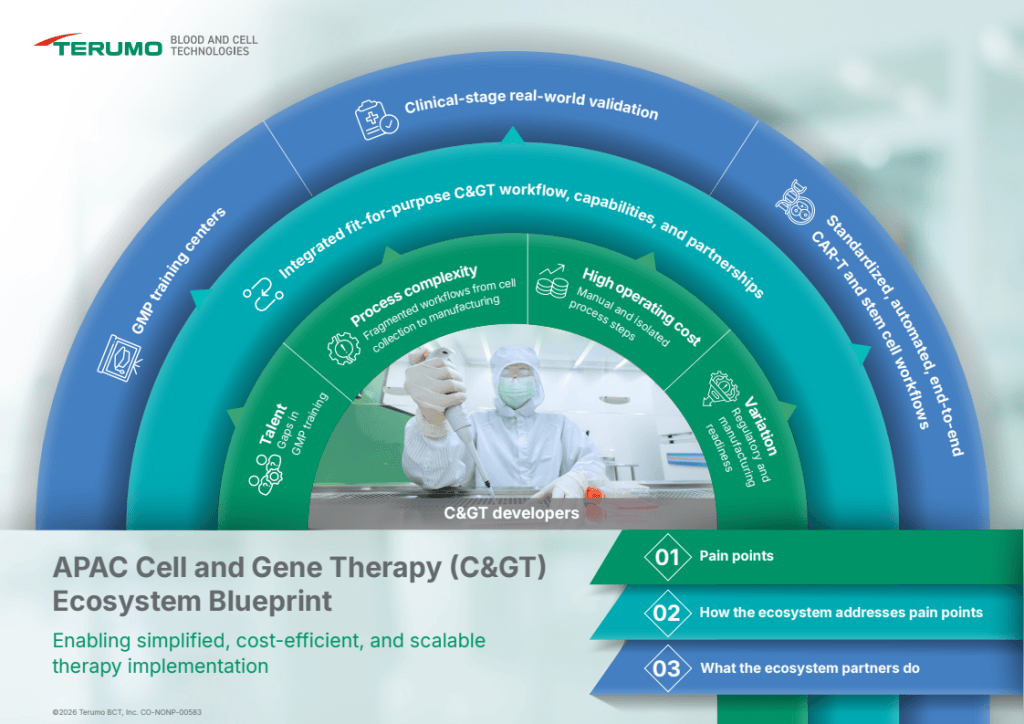
That’s why we launched the Ecosystem Blueprint in March 2026, which helps manufacturers scale and deliver these therapies in a way that’s fast, practical, and financially viable.
Ultimately, our role is to act as the connector across the entire industry. Instead of customers having to build everything from scratch, we provide a coordinated, almost operating-system-like approach, and it’s built around three core components:
Workflow Buildout and Integration
The Ecosystem Blueprint pre-selects and vets best-in-class regional partners for scaling up regenerative manufacturing as a one-stop solution. Instead of manufacturers needing to connect and optimize every step themselves, we’ve already designed and tested the protocols, putting them several steps ahead.
The first workflow integration we’ve built, currently being tested with early adopters, is an end-to-end CAR-T solution. For that, we are working with partners such as GenScript on upstream cell selection and activation, and with EurekaBio on integrated CAR-T manufacturing steps, including transduction and expansion.
If there’s a local hospital making its first foray into CAR-T, they can now come to Terumo and use these tested workflows in a single, modular ecosystem, going from zero to one much more rapidly.
Equipment and Training Protocols
Manufacturing therapies, in general, is unfamiliar to most hospitals, let alone the new regenerative ones. It’s a new department with a novel way of thinking, equipment, and training.
Rather than making every hospital “reinvent the wheel”, our team will simply bring the equipment to their facility and train their teams to install, run, and optimize the full process end-to-end. We’re able to transfer the knowledge from other successful scale-ups and bring it right to the point of care to help local patients in need.
Workforce Development
In addition, we work with government-supported programs to train personnel across manufacturing, quality, and regulatory functions. This is critical because if regenerative medicine is to succeed long term, you’re going to need local talent with specific domain knowledge.
We’ve partnered with KBIOHealth in Korea and the Advanced Cell Therapy and Research Institute in Singapore, both of which have strong workforce training programs for cell & gene scientists.
After CAR-T, what other workflows will be available?
Wenyan: The initial focus is CAR-T because of the immediate need and relatively established protocols, but we’re designing it to be flexible across many cell types and applications.
We’ll announce more in the near future, but mesenchymal stem cells (MSCs) have had an exciting last few years; they’re getting a lot of attention again. There are a handful of approved MSC therapies, such as Ryoncil in the USA and CARTISTEM in South Korea, with several on the horizon, and hospitals are looking to produce them. That will likely be a near-term focus.
We’re also working with the CiRA Foundation to co-develop and standardize iPSC workflows using our equipment for other cell types.
What does success look like in three to four years?
Wenyan: Zooming out, the overall goal is always to help patients receive therapies they need at an affordable cost, whether that’s within our system or not.
The most important lagging indicator for the Blueprint will be seeing our early CAR-T adopters successfully treat patients with locally manufactured therapies. That will gain a lot of valuable data for future adopters.
More broadly, we aim for this to lead to a more mature APAC cell therapy industry. There’s growing global demand; perhaps it will elevate APAC into a competitive manufacturing hub for these advanced therapies. We’ve already seen significant interest, particularly in China and parts of Southeast Asia.
We aim to standardize programs with KBIOHealth and ACTRIS that we can reliably send developing workforces to, and help countries plant the seeds to build out their own programs, too.
Stay Ahead in Regenerative Medicine
Thanks! Please confirm your email using the link we sent from Jeremy@RegenReport.com (check spam too please).
To wrap up, back to the “innovation without access is waste” quote.
APAC is such a dynamic area with some of the most developed megacities and underserved rural communities, but these life-saving therapies need to be available to everyone, and that’s where our mission lies.
Special thanks to Wenyan Leong, Ph.D., for the interview!
You can reach out to her on LinkedIn, and we’ll keep the audience updated on new developments as they unfold.