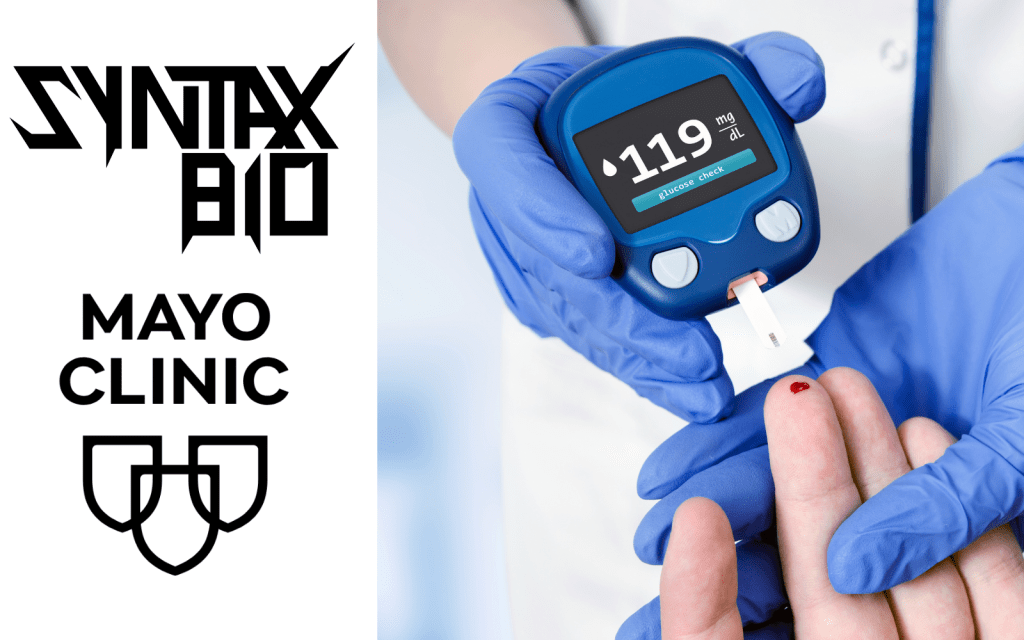
Syntax Bio and Mayo Clinic Partnering on Cell Therapy for Type 1 Diabetes
Syntax is bringing its Cellgorithm cell-therapy discovery platform to the table, while Mayo Clinic will provide expertise in pancreatic biology and functional testing for preclinical diabetes.
Key Points
- Syntax Bio and Mayo Clinic are partnering on stem cell-derived pancreatic cell therapies for type 1 diabetes.
- The work is centered on an allogeneic (donor derived) pancreatic beta cell therapy, with Syntax Bio contributing its induced pluripotent stem cell (iPSC) programming platform and Mayo Clinic providing pancreatic biology and preclinical testing expertise.
- The collaboration aims to improve cell identity, function, consistency, and scalability to support regulatory-enabling studies and early clinical development.
Syntax Bio, a Chicago-based biotech company, has partnered with Mayo Clinic to advance an allogeneic (donor-derived) stem cell-derived pancreatic beta cell therapy for type 1 diabetes.


Syntax Bio is developing Cellgorithm™, a discovery platform that uses plasmid DNA to instruct stem cells to differentiate into distinct specialized cell types. The platform will be used to guide induced pluripotent stem cells (iPSC) into beta cells for administration. Mayo Clinic will contribute expertise in pancreatic biology and functional testing in preclinical diabetes models to support regulatory-enabling studies and early clinical development.
“The collaboration reflects our belief that regenerative medicine must start with precise control over cell identity and function,” said John Craighead, chief executive officer of Syntax Bio. “By combining our Cellgorithm platform with Mayo Clinic’s translational and clinical expertise, we aim to accelerate the development of a next-generation cell therapy with transformative real-world benefits for patients with type 1 diabetes.”
Development Priorities
The teams are working on several practical challenges that come with pancreatic cell therapy development, including:

- Ensuring the cells are the intended cell type
- Confirming the cells function properly
- Producing the cells consistently
- Building a process that can scale for manufacturing
According to the companies, they’ll work in rapid development cycles, using results from functional testing to refine cell identity, maturity, and performance. Programs that meet development milestones may advance through biopharmaceutical partnerships or other avenues to support further development and potential clinical testing.
Technology and Context
Syntax Bio says its Cellgorithm technology is designed to simplify stem cell differentiation by programming the sequence of gene activations needed to create specific cell types. The company says this approach reduces the need for repeated manual interventions and has shown it can generate target cell types in days or weeks rather than months.
The collaboration follows a recent grant award to Syntax Bio from Breakthrough T1D to support work on pancreatic beta cell therapy for type 1 diabetes.
Want to keep up on regenerative medicine? Get the weekly newsletter here.