XellSmart’s iPSC-Derived Dopaminergic Neural Progenitor Cell Therapy Shows Motor Improvements in Phase I Parkinson’s Trial and Completes Phase II Enrollment
All nine Phase I participants received transplants into the bilateral posterior putamen, and serial MRI monitoring showed no aberrant cellular overgrowth or tumor formation.
Key Points
- XellSmart presented Phase I results for XS411, an off-the-shelf iPSC-derived dopaminergic neural progenitor cell therapy for Parkinson’s disease, at the MDS congress.
- All nine Phase I participants achieved clinical improvements, with average OFF-state MDS-UPDRS Part III scores improving by more than 30 points at six months.
- The 30-participant Phase II trial in China has completed enrollment, and XS411 received FDA Fast Track Designation in July 2026.
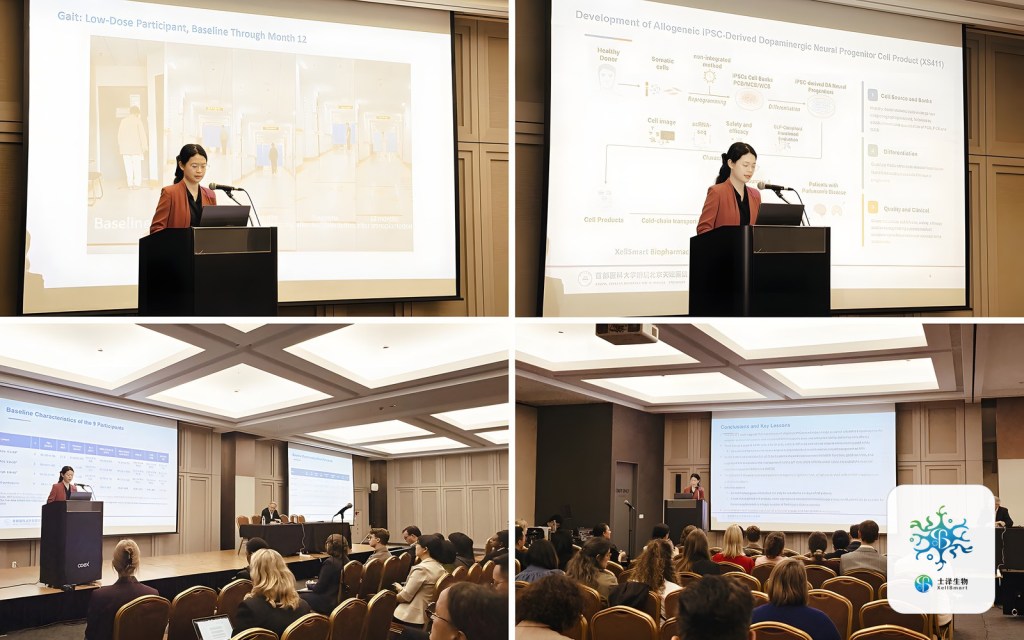
New clinical data for XellSmart Biopharmaceutical’s off-the-shelf cell therapy for Parkinson’s disease were presented at the International Congress of Parkinson’s Disease and Movement Disorders (MDS). During the session Parkinson’s Disease: Clinical Trial, Pharmacology, and Medical Management, an investigator shared Phase I results for XS411 alongside completion of enrollment in its multicenter, randomized, parallel-group Phase II trial in China, which uses an open-label design with blinded endpoint assessment.
Stay updated on Pluripotent news
Thanks! Your signup has been saved.
XS411 is an allogeneic cell therapy candidate comprising induced pluripotent stem cell (iPSC)-derived dopaminergic neural progenitor cells. It is designed for use without patient-specific human leukocyte antigen (HLA) matching and is administered with a standardized immunosuppressive regimen. Following transplantation into the putamen, the cells are intended to differentiate into functional dopaminergic neurons that restore dopamine synthesis and metabolism.
Phase I Findings
The Phase I single-arm, open-label trial enrolled nine participants with moderate-to-advanced Parkinson’s disease into three dose cohorts using a 3+3 dose-escalation design. Mean disease duration was approximately 10 years. All had end-of-dose wearing-off and OFF-state Hoehn–Yahr stages of 3 to 4, with symptoms that remained inadequately controlled with standard-of-care treatment.
Participants received XS411 transplantation into the bilateral posterior putamen. The trial met its primary safety and tolerability objectives, and XS411 was generally well tolerated. No dose-limiting toxicities, serious adverse events, or adverse events considered related to XS411 were reported during the follow-up period. Serial MRI monitoring showed no aberrant cellular overgrowth or tumor formation, and no graft-induced dyskinesia was observed.
All nine participants achieved clinical improvements during the follow-up period, with response magnitudes surpassing published minimal clinically important difference thresholds. For motor function, OFF-state MDS-UPDRS Part III scores improved by an average of more than 30 points from baseline at six months post-transplant. Available longer-term follow-up data showed a trend toward greater efficacy in the higher-dose group compared with the lower-dose cohort.
Patient diaries captured motor fluctuations, a major burden for people with moderate-to-advanced Parkinson’s disease. At six months post-transplant, participants gained an average of more than five hours of good ON time per day, defined as ON time without troublesome dyskinesia. Patient-reported outcomes from the 39-item Parkinson’s Disease Questionnaire (PDQ-39) mirrored these trends, showing concordance between clinician-rated motor function and participants’ self-perceived gains in daily living.
Because open-label trials carry inherent risk of bias in clinician ratings and patient-reported outcomes, the study integrated ¹⁸F-DOPA PET molecular imaging, a globally accepted objective biomarker for assessing dopamine synthesis and metabolic capacity. Post-transplant scans revealed elevated specific binding ratios in the putamen compared with baseline, with areas of increased tracer signal anatomically consistent with the injection sites. According to the company, these data demonstrate that transplanted XS411 cells survive, engraft, and differentiate at the target site to establish functional dopamine synthesis and metabolic capacity.
Phase II PROBE Design
The registrational Phase II study has completed enrollment of all 30 planned participants. Led by Beijing Tiantan Hospital, the trial includes Peking Union Medical College Hospital, the Second Affiliated Hospital of Soochow University, and Jiangsu Province Hospital as participating centers. Cell transplantation has been completed in the treatment group, and follow-up is ongoing.
The trial employs a Prospective Randomized Open-label Blinded Endpoint (PROBE) design, which the company describes as the first stem cell therapy trial for Parkinson’s disease built around this approach. Randomized grouping, parallel-arm comparison, and blinded endpoint evaluation are intended to mitigate research bias. Under the blinded endpoint framework, independent outcome assessments are designed to eliminate subjective investigator bias. The data generated from this study are expected to support the pivotal Phase III registrational trial.
Development Programs
XellSmart states that XS411 avoids personalized cell production and large HLA cell banks, and that combined with standardized immunosuppression it has exhibited preliminary safety and promising efficacy in the Phase I trial. The company describes reproducible manufacturing, GMP-grade production, and robust quality control as necessary for stable multicenter supply.
Two milestones in 2026 support XS411’s development. First, XS411 has secured funding under China’s National Major Innovative Drug Program through a XellSmart-led consortium that includes Tongji University, NIFDC, Beijing Tiantan Hospital, and Peking Union Medical College Hospital. The collaboration was initiated in June 2026. Second, in July 2026, after clinical trial clearance in China and the US, XS411 obtained FDA Fast Track Designation, which enables efficient FDA communication on clinical strategy and trial design and may qualify the program for expedited pathways including rolling review.
XellSmart has established an integrated R&D system covering iPSC reprogramming, directed differentiation, product characterization, quality control, and preclinical safety assessment to manufacture clinical-grade cell products. Analytical tools including single-cell transcriptomics and systematic safety evaluations support product characterization and quality research.
Want to keep up on regenerative medicine? Get the weekly newsletter here.
Similar stories
 Inside Cellular Intelligence: The Zuck-Backed AI Company That Acquired Novo’s Parkinson’s Cell Therapy
 I Peace Wins Top 10 Longevity Breakthrough Award for Cell-Free Stem Cell Technology
 Encellin and Breakthrough T1D Planning Phase 1 of Immune-Protected Cell Therapy for Type 1 Diabetes
 Webinar: Scaling iPSC Therapies Without Scaling VariabilityOn-Demand
 Aspen Neuroscience Publishes Preclinical Data on Parkinson’s iPSC-Derived Cell Therapy
 Made Scientific Acquires Resilience’s 85K-Square-Foot Cell Therapy Facility
 Kincell Bio and Cellipont Bioservices Merge to Form Kincellis Advanced Therapies
 Ernexa Therapeutics Reports Positive Preclinical iPSC-Derived Mesenchymal Stem Cell Study, Advances Oncology Strategy